“The Art of Hadrons”: Miniaturised Imaging Technology Undergoes Extreme Radiation Testing at CERN
The European Space Agency (ESA) has selected a captivating image of a chequerboard pattern, speckled with bright dots and streaks, as its Technology Image of the Week. Titled "The art of hadrons," the image illustrates the performance of an extremely miniaturised imaging system developed by the University of Maribor in partnership with SkyLabs under the TRISAT programme, marking a significant milestone in the validation of next-generation space technologies.
The tiny camera – about the size of a 20-cent coin’s edge – originally tested this miniaturised imaging technology in space three years ago aboard the European Space Agency’s shoebox-sized TRISAT-R CubeSat, developed by the University of Maribor in Slovenia, in cooperation with SkyLabs, where it had to endure the harsh environment of medium Earth orbit. Recently, as part of an ESA General Support Technology Programme (GSTP) activity and enabled through the RADNEXT project, the TRISAT team pushed the technology even further with an accelerated radiation campaign at CERN’s CHARM facility to explore its potential for spacecraft attitude and orbit determination. The campaign exposed the miniature camera to an intense mixed-field particle environment covering a broad spectrum of particles and energies relevant to space applications. In CHARM, the camera faced conditions associated with radiation trapped by Earth’s magnetic field or emitted by the Sun during solar particle events.
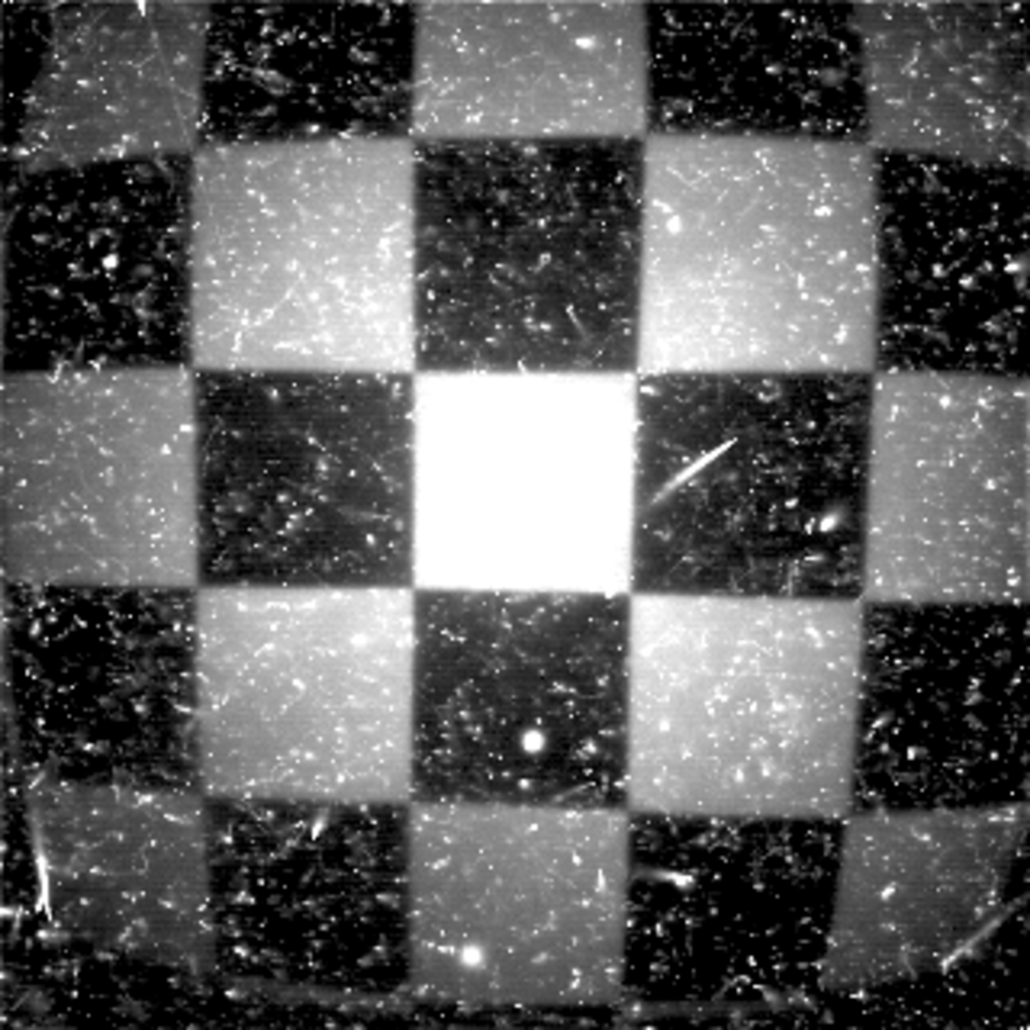
During the test, the imaging system spent more than 108 hours in the CHARM chamber, exposed to a mixed-field radiation environment containing high-energy particles, including hadrons such as protons, neutrons, and pions. Pointed at a 13 cm wide chequerboard which served as a reference pattern, the camera acquired over 4 million images at a rate of 10 frames per second. Of these, more than 160,000 images were kept for detailed analysis to study radiation-induced pixel activation and the subsequent recovery of the image sensor following particle interactions. The images are speckled with white dots and streaks called ‘radiation-induced artefacts’. Each one is caused by an energetic particle traversing the image sensor, illustrating the challenges that imaging systems face when operating in harsh radiation environments like space.
Professor dr. Iztok Kramberger, head of the TRISAT programme at the University of Maribor and CINO at SkyLabs, explains the significance of the campaign: "Our tiny imaging system spent more than 108 hours in the CHARM chamber, exposed to mixed-field radiation environment containing high-energy particles, including hadrons such as protons, neutrons and pions. For this test we have joined forces with SkyLabs, who implemented protection mechanisms into the camera system to make sure the intense radiation doesn’t cause any permanent damage or loss of functionality."
He further elaborates: "By analysing the large dataset acquired during this campaign, we are investigating the frequency and spatial distribution of radiation-induced artefacts, the number of pixels affected by each event, how and when affected pixels recover, and how to distinguish transient, recoverable effects from permanent radiation-induced damage."
The insights gained will directly support the development of even more robust image processing algorithms and contribute to the integration of this miniature imaging technology into SkyLabs’ next generation of product lines for satellite attitude and orbit determination and control (AOCS). Compared to conventional solutions on the market, the new generation of systems will offer significantly higher accuracy, improved redundancy, additional functionalities, and a drastic reduction in size, weight, and cost, further strengthening SkyLabs’ position among the world’s leading providers of space technologies.
Building the Foundations of Autonomous Spacecraft
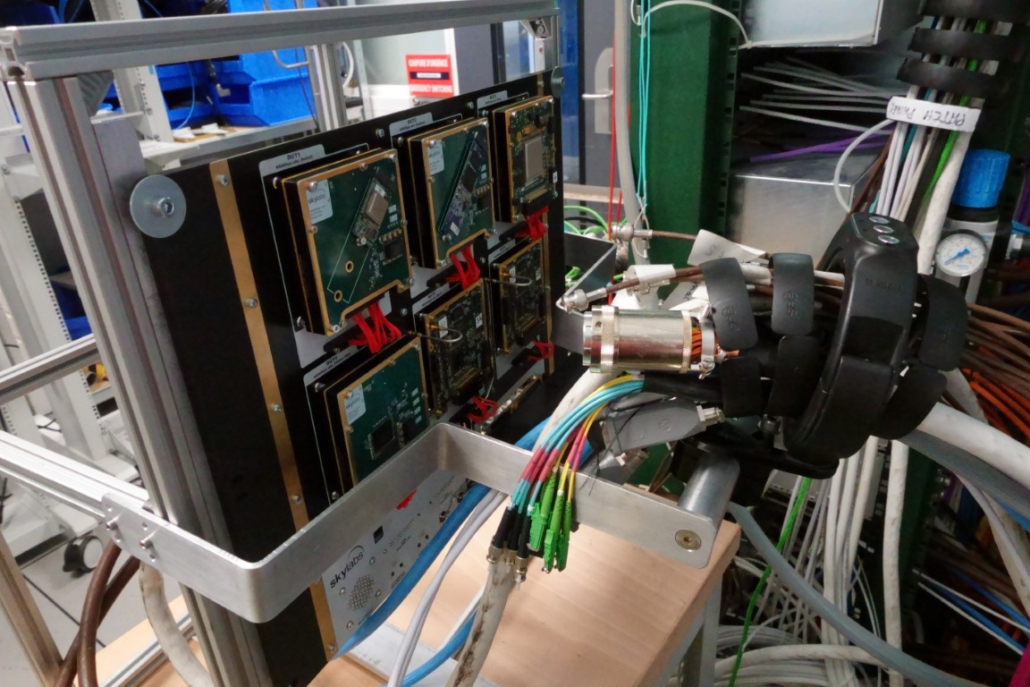
What this image does not reveal, however, is that the miniature camera represented only one element of a much larger technology validation campaign conducted by the University of Maribor and SkyLabs at CERN's CHARM facility.
The objective was not merely to test individual electronic components, but to evaluate complete onboard information-processing infrastructures as the foundational building blocks of future autonomous orbital data systems. As modern spacecraft continue to generate increasing amounts of data, onboard processing is becoming essential. Rather than transmitting all collected data to Earth, future spacecraft will need to process, interpret, prioritize and store information directly in orbit.
This shift fundamentally changes the role of onboard computing. Future spacecraft will increasingly rely on artificial intelligence (AI) to transform raw sensor data into actionable information before transmission to Earth, effectively downlinking insight rather than data.
AI Processing and Large-Scale Data Under Radiation
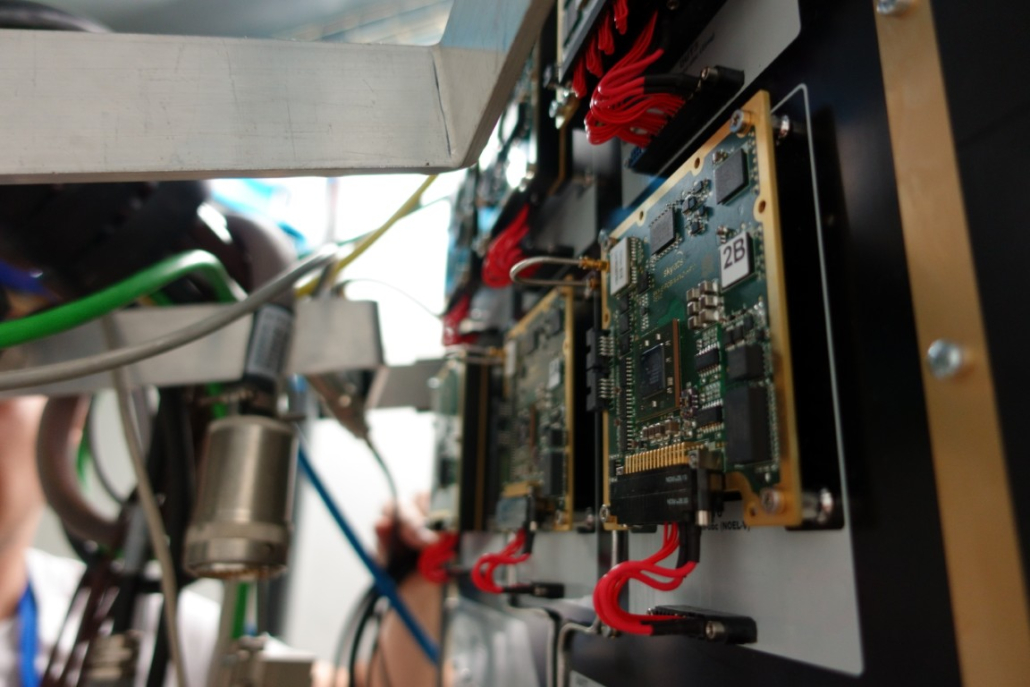
The campaign accumulated more than 160 hours of autonomous AI operation across multiple AI processing platforms, providing valuable insight into the behavior of modern energy-efficient AI architectures under radiation exposure. The results indicate that such modern energy-efficient AI accelerators are becoming viable building blocks for future autonomous spacecraft capable of processing data directly in orbit, reducing reliance on ground-based analysis.
The CERN campaign also included the evaluation of high-capacity PCIe-based non-volatile storage technologies intended for future data-intensive space missions. As onboard sensing capabilities evolve, storage capacity is becoming a strategic resource in its own right. Future Earth-observation, hyperspectral and scientific missions will require spacecraft not only to collect data, but also to retain, organize and process large volumes of data directly in orbit. Combining high-capacity storage with onboard AI significantly reduces dependence on downlink bandwidth while increasing system autonomy.
The true innovation lies not in the standalone high-performance computing, AI acceleration, or mass storage, but in their seamless integration into a unified, resilient, and autonomous onboard infrastructure.
Towards Autonomous Space Data Centers
As sensing technologies continue to mature and miniaturize, the primary challenge is no longer data acquisition, but the efficient onboard interpretation of rapidly growing data volumes—beyond the limits of traditional “collect-and-downlink” approaches.
In this context, future spacecraft may increasingly resemble autonomous space data centers, where sensing, storage, networking and AI operate together as a unified onboard information-processing infrastructure. These systems will not only collect data, but also process, interpret, prioritize and store information directly in orbit, enabling a new generation of highly autonomous space missions.
The CERN campaign thus demonstrated not only individual technologies, but the first building blocks of future autonomous space data systems.